
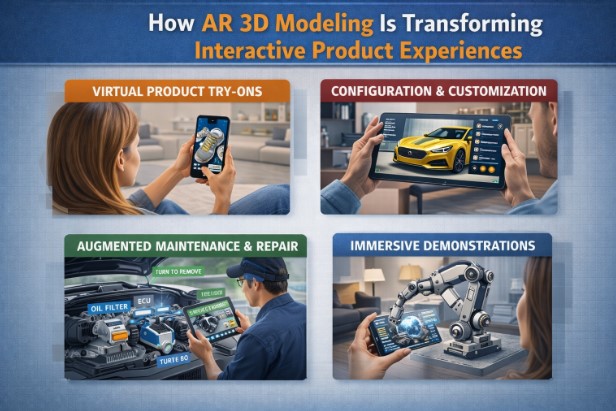
Customer expectations around the interaction with products have enormously shifted. Static images, flat videos, and basic product descriptions are just not good enough to inspire confidence or engagement, particularly for complex or high-value products.
They want to understand the scale, functionality, and feel confident in their decisions about products. This has pushed brands into embracing immersive technologies, one of the most powerful tools being AR 3D modeling, in transforming how products will be digitally experienced.
AR reimagines engagement in everything from retail and manufacturing to real estate and B2B sales by integrating accurate 3D assets into the real world.
From Passive Viewing to Active Interaction
Traditional product visualization has been passive-a customer looks at images or videos rendered at fixed angles and leans on imagination to fill in the gaps. AR totally upends that dynamic.
AR-powered product experiences allow users to:
- Rotate, zoom, and inspect products freely.
- View products at real scale in their own environment.
- Engage with features rather than simply passively perceive them.
In fact, the very shift from mere viewing to interaction is engaging in itself, which makes them relate more strongly to the product.
Building Buyer Confidence with Context
One of the biggest barriers to a purchase, especially online, is uncertainty. Uncertainty creates customer hesitation when customers cannot judge the size, fit, or appearance of anything in realistic settings.
AR experiences solve this by placing digital products into physical environments. Furniture can be seen inside a living room, machinery inside a workspace, or consumer products on a desk or a shelf.
This contextual visualization:
- Reduces guesswork
- Sets realistic expectations.
- Reduces the chances of post-purchase dissatisfaction.
This naturally leads to quicker and more confident decisions by buyers.
Improved Product Understanding in Complex Offerings
Not all products are simple or self-descriptive. Industrial machinery, electronic components, medical devices, and configurable products have contents that are difficult to explain through traditional media.
AR-based models allow us to:
- View internal components
- Visualize usage or assembly steps
- Learn functionality by doing
AR 3D modeling really resonates in the middle of that experience journey, where articulating how products work, not just how they look, becomes instrumental in bridging the gap between curiosity and comprehension.
Drive Engagement in Retail and E-commerce
E-commerce and retail are some of the fastest adopters of AR.
AR interactive product experiences help:
- Spend more time on product pages.
- Reduce product returns due to mismatched expectations.
- Create memorable brand interactions.
This suggests that customers who are able to virtually engage with a product feel more informed and more emotionally invested, which ultimately drives conversion rates.
Supporting Sales & B2B Product Demonstrations
Product demonstrations in B2B sales can be very costly, time-consuming, and even logistically complex. Many times, it is either not practical or possible to physically move large equipment around or set up in-person demos.
AR product experiences allow sales teams to:
- Showcase products anywhere without physical samples.
- Personalize presentations for particular client needs.
- Interactive highlighting of features during meetings.
This flexibility hastens sales cycles by bridging communications between technical teams and decision-makers.
AR-enabled content can be used to:
- Websites and mobile apps
- Social media campaigns
- Trade Shows & Virtual Events
This allows for quicker marketing to begin and the consistent use of all channels with the appropriate depiction of the product.
When well-designed, AR models:
- Ensure accuracy across teams.
- Reduce duplication of effort.
- Provide consistency in design and customer touchpoints.
Most companies would hire professional 3D modeling services to develop building assets that match both technical and experiential demands for seamless integrations across platforms.
Reduce Returns & Post-Purchase Friction
Returns in general are a very costly problem, especially within e-commerce. Most returns occur when products fail to meet expectations upon arrival.
By letting customers accurately preview products before buying, AR:
- Reduces size and fit mismatches.
- Sets realistic visual expectations.
- Enhances post-purchase satisfaction.
It not only reduces return rates but also builds long-term brand trust.
Enabling Personalisation and Configuration
Personalization is a key driver in today’s consumer behavior. AR enables intuitive and interactive product configuration.
Users can:
- Change colors, materials, or finishes in real time.
- Compare variations side by side.
- Visualize bespoke products before ordering.
Interactivity of this type provides personalization that creates perceived value and fun during the buying process.
Expanding Accessibility across Devices
Accessibility now enables brands to:
- Reaching wider audiences.
- Create frictionless experiences that immerse.
- Seamlessly integrate AR into existing digital platforms.
And as AR becomes more mainstream, expectations for interactive product experiences will only rise.
Long-term Value Beyond Marketing
AR assets are not a one-time investment: well-made 3D models can be reused and repurposed for years over countless use cases.
They support:
- Training and onboarding
- Customer Support and Troubleshooting
- Future Product Updates & Variants
Long-term flexibility further raises the overall return on investment in digital assets.
Conclusion
In other words, interactive product experiences ceased to be optional; they actually emerged as one of the key drivers in the way customers choose, understand, and trust the products. Allowing real-world visualization, deeper interaction, and clearer comprehension, AR 3D modeling basically changes how products are experienced, from heavy industrial plants to everyday products like groceries. Working strategically, it enhances engagement, reduces uncertainty, and cements the bond between brands and their customers in an increasingly digital marketplace.

